Dr Amin Hashemi
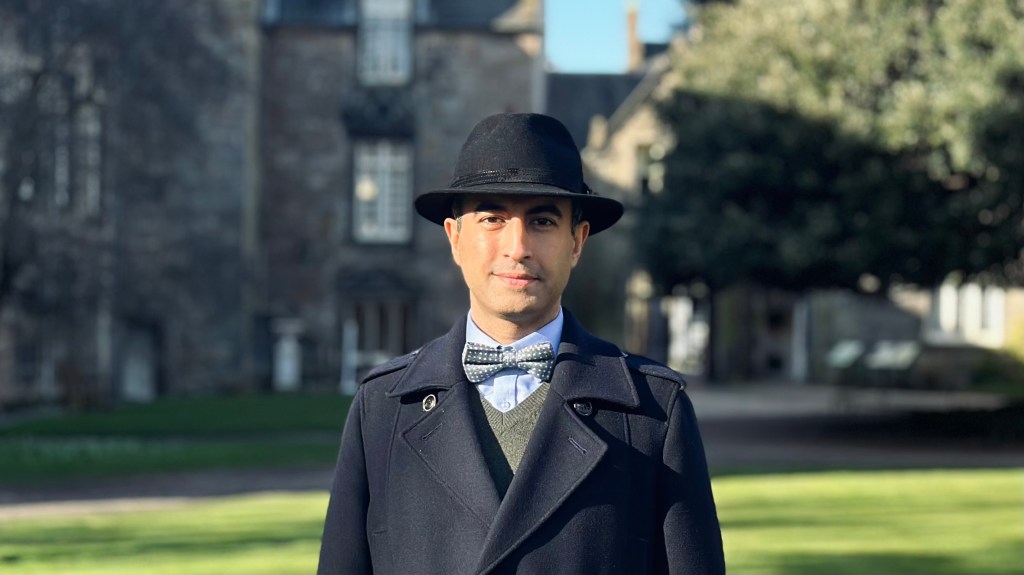
Thanks for visiting!
I am a scholar in cultural history of Iranian music. I use interdisciplinary frameworks to investigate my research interests in Iran’s musical expression, dynamics of creativity and its links to subjectivity as well as the cultural encounters of Iranian musicians and elites with the Global North. I am also interested in the relationships between socio-cultural dynamics in urban developments, creative practices and human senses in general. I love music; particularly classical Iranian music, Western Classical music, choral music, popular Iranian of the 1970s, jazz and popular music of the 1940s in the UK and the USA. I am also a humble electric guitar, bass and tar player.
Click on the drop-lists below to learn more…
About
I am an interdisciplinary scholar of arts and humanities. I studied and worked in Iran and the UK, exploring subjectivity, creativity and communications in the realms of music, culture, technology and everyday life, employing ethnography, philosophy and psychoanalysis.
I have a passion for exploring the intersections of various academic disciplines. My journey in academia has been a dynamic exploration of computer science, neuroscience, psychology, psychoanalysis, art research, and musicology.
I began my academic pursuits by earning a BSc in Computer Science at the University of Tehran in 2011. I was primarily interested in graph theory, big data models, machine learning and artificial intelligence. During this time, I discovered my fascination with neuroscience, which led me to delve deeper into the realms of psychology and psychoanalysis.
In pursuit of my multidisciplinary interests, I then embarked on an MA in Art Research at Azad University of Tehran where I immersed myself in poststructuralist discourse analysis, examining the paradigm shifts of classical Iranian music in the 1960s. My dedication and research excellence were recognised when my dissertation received an award from the school.
Driven by my passion for exploring the cultural dimensions of music, I ventured to London in 2014 to pursue a fully funded Felix scholarship at SOAS, University of London. Here, I started my PhD journey, focusing on the topic of “Antagonism in Popular Music of Post-Revolution Iran.” To unravel this complex subject, I developed an interdisciplinary framework that integrated discourse analysis and ethnography. This unique approach allowed me to delve into the Iranian society and politics through the medium of popular music inside and outside of Iran.
After completing my PhD in 2019, I continued my academic journey as a Research Associate at SOAS, where I collaborated on various projects. Additionally, I served as a Research Fellow at the Institute for Social and Cultural Studies in Tehran in 2021. During this time, my focus shifted towards studying the social space of rock music in modern Iran, with a particular emphasis on post-revolution universities in Tehran.
I held the esteemed position of a Leverhulme Early Career Research Fellow at the Music Department of the University of Aberdeen in Scotland between 2022 and 2025. My project focused on the intricate dynamics between musical creativity and the integration of migrant musicians with an Iranian background into the UK.
This compelling research endeavour spans. Through the lens of ethnography and psychoanalysis, I explored the complexities of how music interwinds with individual and collective experiences, identities and social structures.
Through my diverse academic background and interdisciplinary research, I have gained valuable insights into the complex interplay between culture, music, and society. I am passionate about fostering dialogue, understanding, and critical thinking across disciplines, and I continually seek opportunities to engage with fellow scholars and enthusiasts in these areas.


Education
- PhD, Media Studies (2014-2019) SOAS, University of London, UK.
- MA, Art Research [taught-research] (2011-2013) Azad University, Tehran, Iran.
- BSc, Computer Science + Music (2005-2010) University of Tehran, Iran.
Research
The Creative Processes of Subjectivity for Iranian Musicians in the UK.
PI in the Leverhulme Early Career Fellowship at the Music Department, University of Aberdeen, (Scotland, UK). 2022-2025.
Drawing on ethnographic interviews and observational methodologies in the light of psychoanalytical ideas of Jacques Lacan, this research examines how different generations of Iranian migrant musicians in the UK constitute their subjectivity and facilitate social integration through musical creative processes. In so doing, it develops an innovative approach to an established body of research in ethnomusicology on migration by applying psychoanalytical frameworks to existing issues around the relationship between diasporic creativity and social integration and multiculturalism. The movement of the musicians is taken as an ongoing process and not an event in the past. It would be argued that the movement of music and the musicians are sociocultural processes that take two notions at their heart: integration (or resistance to it) and loss. The next step is then to discuss why some cultural policies regarding the integration of minorities, especially musicians, could be problematic concerning the diversity of the spectrum of their backgrounds in their homeland and the UK. Bringing together ideas from migration studies, ethnomusicology, and Lacanian post-structuralist psychoanalysis, this framework maintains an open and simultaneously critical take on the fieldwork findings in the next two weeks throughout the UK.
Output:
Their Iran and Our Britain: An Ethnographic Understanding of Musical Creativity, Belonging and Integration of Musicians with Iranian Background in the UK (2024). Special Issue of Ethnomusicology Forum, UK.


The Practice of Rock Music as Differentiation in the Process of Subjectivity of Young Iranians in Universities.
PI in the Post-Doctoral Fellowship at the Cultural Studies Department, Institute for Social and Cultural Studies (Tehran, Iran). 2021-2022.
Looking carefully into the faculties of engineering in top Iranian universities in Tehran between the 2000s and the 2010s illuminates the presence of certain musical social spaces – of less-known types of music, such as progressive rock. Many Iranian rock bands started making music once they got to know each other in these social spaces. I investigated the correlations between the constitution of subjectivity and the social space as well as the dynamics of such correlations in the context of university — as a different social space compared to other public places in Iran. I took both the social space (of the University and those the young Iranians pushed for into the public space such as art houses) and the practice of music as sites of objectivisation of a prolonged sociocultural antagonism in Iran. The research is based on ethnographic methodology and interviews with the band members who has been active since the 2000s to unfold the complex social relations embedded into the practice of rock music in Iran and the specificity of the university space as a site of cultural production.
Output:
Dominant Suspended Compulsions: The Complex Relationship between Rock Music, Youth Subjectivity and the Social Space of Iranian University (2024) (In Preparation) Peer-Reviewd Journal Article. Popular Music, University of Cambridge Press, UK.
Staged and Floored: Alterations of the Social Space of Rock Music in Iran (2024). Journal of Popular Music Studies, University of California Press, USA.
برساخت سوژه متمایز در فرآیند تولید موسیقی مردمپسند در محیطهای دانشگاهی (۱۴۰۲). موسسه مطالعات فرهنگی و اجتماعی. تهران. ایران
* Network Member at the AHRC funded project The Inner Music and Wellbeing with the PI Professor Freya Bailes. since 2024. Link
* Network Member at the Leverhulme Trust funded project Sonic Tehran with the PI Professor Laudan Nooshin. 2021-2023. Link
Hegemonic Shifts in the Discourse of Air Pollution in London
Research Associate, Bloomsbury SET Sandpit: COVID Response: Understanding people, business and culture in combating infectious disease and antimicrobial resistance. Centre for Global Media and Communication, School of Interdisciplinary Studies, SOAS University of London, (London, UK). 2020-2021.
I investigated the dynamics of olfactory awareness of London’s air quality comparing the Great Stink of 1858 with the odourless pollutants of contemporary times. This project aimed to understand how the sense of smell has been perceived and conceptualised in relation to pollution and freshness to provide a deeper understanding of how the sensory subjectivities are consciously and unconsciously articulated through. The study took the human body and the air as media of sending and receiving of olfactive as well as tomato-cultural meanings. It adopted an interdisciplinary approach, integrating ethnography, media studies, psychoanalysis and bio-chemistry sciences, to gain a comprehensive understanding of the olfactive perceptions in urban areas. The concept of “smellscape” was utilised to capture subjective experiences and feedback.
Output:
Olfactive Paradigms of Air Quality: From the Great Stink to Odourless Particulates (2024). in Routledge History of Senses. Edited by Andrew Kettler and William Tullett.
Antagonism in Popular Music of Post-Revolution Iran
Fully Funded PhD, Interdisciplinary Media Studies, SOAS University of London (London, UK). 2014-2019.
I examined the political disputes that characterised popular music in post-revolution Iran. After the 1979 revolution, Iranian officials muted the practice of popular music at first but developed a controlled adaptation later. I explored the social history of Iranian popular music through archival research and conducted ethnographic interviews with musicians and authorities both in Iran and in the diaspora. I questioned the overlooked and polarised notions of youth cultural resistance and censorship in Iran. My Thesis revealed that the antagonist, exploitative and stigmatising relationship between officials and artists is bilateral.
Output:
Tataloo and His Multiple Morphologies (2023) co-author: Roya Arab. Edited by Prof. H. Chehabi and Dr. N. Siamdoust. in ‘The Nightingale Rebels: Popular Music & Society in Modern Iran’. Ilex Foundation, Harvard University Press, USA.
Sonic Performances in a Time of Turmoil in Contemporary Iran (2019). Music and Arts in Action, University of Exeter, UK.
Power and Resistance in Iranian Popular Music (2017) Popular Music Studies Today, Part of the Systematische Musikwissenschaft book series (SYMU), Springer, Germany.
Discourses of Revivalism in Classical Iranian Music during the 1960s-1970s.
MA Dissertation, School of Arts, Azad University (Tehran, Iran). 2013-2014.
I studied the domination of ‘revivalist’ discourses in Iranian music in the 1960s. I revealed how these discourses transformed the policies, artistic values and eventually the repertoire of classical Iranian music while ill-informed by a misreading of ‘authenticity’. Revivalists rejected the hybrid musical methods such as harmonisation and scripting that were developed by Iranian musicians who trained in Europe since the 1940s.
Output:
A Discursive Study of Music in Iran during the 1960s (2016) The Middle East in London, Volume 12, Number 2: Persian Music, London, UK.
Awards
- Leverhulme Early Career Individual Fellowship (2022-2025)
- Iran Heritage Foundation events grant (2025)
- Recognised as Global Talent by the British Academy (2022)
- The Vice-Presidency of Science & Technology Postdoctoral Grant (2020-21)
- Felix Full-Fund PhD Scholarships (2014-17)
- SOAS, University of London Fieldwork Grants (2016)
- Conference Fundings (2017, 2018, 2019) ASA, BFE, RMA, IASPM.
- Premier MA Dissertation Award in Art and Humanities by Azad University of Tehran (2013)
Publications
Published
Tataloo and His Multiple Morphologies (2025) Peer-Reviewed Book Chapter. co-author: Roya Arab. Edited by Prof. Houchang Chehabi and Dr. Nahid Siamdoust. In Iran Amplified: One Hundred Years of Music and Society. Ilex Foundation, Harvard University Press, USA. 9780674302846. (Link)
Amir Tataloo is a grassroots self-made Iranian musical artist from a working-class background. He was amongst the first post-revolutionary Iranian artists to produce music without regard for state protocol, bypassing regulatory and censorship systems for cultural output in Iran. Tataloo developed his musical style in Dubai between 2002 and 2007, largely based around hip-hop and R&B, with love themes for his lyrical content. His songs were circulated hand in hand and his music was particularly popular at house parties in Iran. By 2005 his music videos were broadcast on satellite TV channels linking Iranian diaspora and Iranians living in Iran. Tataloo was amongst a series of artists who gained attention from the Iranian diaspora media including BBC Persian and Āvang Music. By 2007 he was a celebrity within and outside of Iran and in the same year during a visit to Iran, he was detained briefly and questioned by state security due to his collaboration with diasporic media and artists who openly criticized the Islamic Republic of Iran, henceforth IRI. Tataloo continued producing his music in Dubai, however by 2013 his lyrics began to express discontent with the Iranian diasporic musicians, Manoto TV and a certain yearning for Iran, which all crystallized in the track “Khuneh Khub-e” (Home is Good, August 2013). One month later upon entering Iran, he was detained by the IRI’s security forces again and soon after published an open letter on his Instagram and Telegram platforms, apologizing to the state for crossing the red line in his cultural activities and his naivety in collaborating with the state’s ‘cultural enemies’. Between 2013 and 2018, during his time living in Iran, he produced a handful of songs in favor of the state’s politico-cultural interests, including “Enerji-ye Hasteh-I“ (Nuclear Energy), which openly supported an ‘armed’ Iran,; and in his social media posts, he further propagated the state’s ideological narratives, such as supporting the IRI’s take on hijab and religious practices. These public gestures were in marked contrast with his personality and artistic history. Such questionable ‘conversions’ towards the IRI’s interests made him a controversial figure amongst his fans, the Iranian diaspora, IRI supporters, and the very same disbelieving public that the IRI had attempted to reach through their musical pawn, Tataloo. Following a series of public and social media confrontations, Tataloo made his final departure from Iran and migrated to Türkiye in 2018, where he remains at the time of this writing (July 2022), producing music that criticizes the IRI. The following section sets out the conceptual frameworks for analysis of Tataloo’s artistic output, before continuing to a study of Tataloo’s music – set within the socio-political context of its production – with considerations of the implicit manipulations by Tataloo and the IRI.
Olfactive Paradigms of Air Quality: From the Great Stink to Odourless Particulates (2025) peer-reviewed book chapter in Routledge History of Senses. Edited by Andrew Kettler and William Tullett. 9781032345871 (Link)
This chapter is based on the idea that the understanding of air pollution via the sense of smell is based on the cultural contexts, unconscious articulations of the discourses and the complicated relationships between smells, people and their interactions with the urban environments. Although the olfactory understanding of the air quality is commonly linked with the perceptions freshness and purity as well as putrid and filth, but these understandings have gone through hegemonic shifts. In addition, the pollutants that impact the air quality changed over time to an extent that some major contributors now do not smell to humanswhereas in Victorian London, air pollution could mostly bee seen and smelled. Therefore, while the sense of olfactory could be a medium of understanding the pollution, the dynamics of conceptualisations and olfactory awareness of air pollution in centuries have had subconsciously manipulated conscious sensory responses. To reveal some of such hegemonic and molecular shifts, this chapter takes and interdisciplinary scope in comparatively studying the 19th century industrial settings to the current issues of air quality,the everyday life practices of Londoners and the socio-cultural context of their behaviours.
On the History of Iranian Popular Music in Germany (2023) Short Essay chapter. in «Klangteppich V Magazine» Edited by Franziska Buhre, Norient Books. Berlin, Germany. 9783952544457. (Link)
In comparison to Los Angeles, there was never an Iranian «community» of popular musicians in Germany. Nevertheless, Iranian popular musicians and scholars debating popular music left their traces. In this overview, musicologist and anthropologist Amin Hashemi discusses the most important of these, and asks why some were more successful than others.Popular music in Iran, as it is known in the West, had one foot in the local and street music of the Centre and South of Tehran – as well as the surrounding Northern villages such as Tajrish – and the other foot in the consumption of Western popular music since the 1960s. The latter led to the formation of many TV talent shows, occasional and promotional performances, with their peak in the 1970s. After 1979, artists such as Leila Forouhar and Ebi, who immigrated to the U.S. between the 1980s and the 2000s, became the emerging stars of these shows . These artists gradually built an Iranian community of popular musicians in L.A., with their music known as Losangelesi.
Sonic Performances in a Time of Turmoil in Contemporary Iran (2019) Peer Reviewed Journal Article. Music and Arts in Action, University of Exeter, UK. (Link)
This article examines sonic performances that refer to traumatic events in post- revolutionary Iran. It is based on archival and historical research, as well as on interviews with experts and field observations. It compares the sounds of the 1980s with those of contemporary Iran to understand the dynamics of generational transformation of cultural ideas about resilience and resistance. It begins by exploring the quality of resilience in a revolutionary society entangled in an eight- year war. This section examines the official elitist approach to art as ideological resilience. It also maps the dramatic mobilisations of the earlier revolutionary devotees who volunteered for the war. The ideological understanding of religion is compared to an unofficial bottom-up sonic performance of emotional resilience during the 1980s that stems from conventional popular perspectives on religion. Earlier articulations of art as resilience were expressed through the notion of serenity and embodied in a gentle approach to devotion and comprehension. In contrast, cultural resilience gradually transformed into a more antagonistic, segregationist and violent concept. The article reflects on earlier notions of resilience as set against an unstable post-war society defined by cleavage and disintegration. The 1990s was an era of cultural vacuum, political division and militaristic cultural suppression. It was characterised by a degeneration of earlier moral understandings of resilience, the over-flow of militarism into daily life, the top-down politicisation of morality and the de-politicisation of lifestyles. The article concludes with an account of the cultural transformations after 2009.
Power and Resistance in Iranian Popular Music (2017) Peer-Reviewed Book Chapter. edited by Julia Merrill. Popular Music Studies Today, Part of the Systematische Musikwissenschaft book series (SYMU), Springer, Germany. (Link)
The case of popular music of post-revolution Iran is believed to be so controversial since being advocated as a challenge towards religious structures, political power and social injustice and gender issues by some officials, media and academics. This paper looks at wider opportunities of studying popular music as a form of popular culture with respect to the social relationships of power and resistant in comparison to some other literature that were limited to state political conceptual- isation of power and resistant, amalgamation of popular music and art music, Eu- rocentric analysis over popular music in the Middle East as the production of so- cial classes, as well as other pathological studies inside Iran concerning generation gap and youth culture. Alternatively, this paper revises repeatedly mentioned facts and events in literature and then (re)contextualises and reinterprets the concept of popular music, power and resistance in contemporary Iran. The result is a wider understanding of the social struggles over several discursive representation of pop- ular culture beyond politics, social classes, religion, etc.
A Discursive Study of Music in Iran during the 1960s (2016) Journal Article. Edited by Nadje Al-Ali et al. The Middle East in London, Volume 12, Number 2: Persian Music, London, UK. (Link)
The standard way of studying music is to examine its history, genre, form and aesthetics. Posing essential questions – such as how and why each musical movement or genre emerged – might be just as interesting. Like all human endeavours, music is ‘created’ within a particular social and cultural context; the process of ‘creation’ is not isolated or independent, but is a blend of elimination, absorption, assimilation, and projection of socially constructed concepts. By situating music within its unique social context, one may gain a better understanding of why different musical movements, such as the innovations introduced by ‘Ali-Naqi Vaziri’s Superior School of Music (Madreseh-ye Ali-ye Musiqi) on the one hand, orthe traditionalist school of music on the other, waxed or waned in Iran during the 1960s.
Digital Tools for Iranian Music (2014) Peer-Reviewed Book Chapter in Farsi. Edited by Mohammadreza Moridi. Matn, in collaboration with Iranian Academy of Arts. ISBN: 9789642322251, Tehran. Iran.
در اوایل قرن بیستم میلادی اولین ایدههای ضبط موسیقی ایرانی و ثبت آن روی کاغذ در این کشور شکل گرفت و رفتهرفته نحوهی نوشتن موسیقی ایرانی به صورت نت غربی با افزون کردن علائم و نشانههای موسیقی خاصّ ایرانی توسط وزیری و سپس دیگران، این فن تکامل یافت و تا کنون نیز ادامه دارد. اما در دوران معاصر با ظهور فنآوریهای جدید رایانهای از جمله نرمافزارهای نتنویسی با کیفیت صوتی بالا و واسط کاربری ساده و کارا برای تولید و ویرایش موسیقی کلاسیک غربی و یا پاپ، راک، و غیره، خلاءی در زمینهی نحوهی ثبت و یا خلق موسیقی ایرانی حس میشد. البته در ایران نیز به دلیل نیازهای روزافزون هنرمندان اقداماتی صورت گرفته است و نرمافزار «آهنگساز فارابی» تا حدود زیادی این خلاء را پر کرده است، زیرا علاوه بر داشتن امکانات معمول نرمافزارهای موسیقایی غربی همانند انواع سازهای ارکستری و غیر ارکستری، تکنیکهای سازی و تقریباً علائم نگارشی موسیقی، این امکان را نیز برای کاربر فراهم آورده است تا به سرکلیدهای پنج دستگاه موسیقی ایرانی دسترسی داشته باشد، فواصل میکروتونال را بسته به نظر شخصی خود تعیین کند، تکنیکهای نوازندگی خاصّ تار و کمانچه به هنگام نتنویسی را لحاظ کرده، بتواند سازهای غربی و ایرانی را در کنار هم به کار برد و نیز جالبتر آنکه از کیفیت صدای شبیه به واقعیت تار و کمانچه هنگام پخش و ویرایش بهره ببرد. این نرمافزار نه تنها موجب سهولت و صرفهجویی در وقت و هزینه در تولید موسیقی ایرانی و تحول در نحوهی انتقال تجربیات بین موسیقیدانان و نیز آموزش موسیقی شده است، بلکه راههایی را نیز در خلاقیت و نوآوری موسیقایی گشوده است.
Reviews
(2024) Review of Sonic Signatures: Music, Migration and the City at Night, edited by Derek Pardue, Ailbhe Kenny and Katie Young. IASPM Journal, 14(1): 186-189
(2020) Review of Soundtrack of the Revolution: The Politics of Music in Iran, by Nahid Siamdoust. Middle East Journal of Culture and Communication 13: 117–122
Under Press
In preparation
Debating Integration Frameworks versus the Creative Interplay of Subjectivity of an Iranian Musician in the UK (2026) Peer-Reviewed Journal Article. Special Issue of Ethnomusicology Forum, UK.
The intersection between migration, musical creativity, and wider scholarly and public debates regarding multiculturalism cannot be understood without also considering the subjectivities of migrant musicians. A focus on subjectivity nuances prevalent debates around multiculturalism that focus on the ‘culture concept’ when it comes to social integration. This is because concepts such as ‘the social’ and ‘the cultural’ are both arbitrary. This article approaches these debates from the perspective of subjectivity and musical creativity among Iranian migrant musicians in the United Kingdom. There is no rigid concept of ‘the’ British culture to be integrated into or ‘the’ Iranian culture to be representative of. The article refers to Lacanian psychoanalysis to argue that the formation of subjectivity and the various forms of integration are processes rather than moments. In this sense, the migrant cannot be taken for granted as a representative of ‘the Iranian culture’ that needs to be ‘preserved’. Once ‘culture’ is taken no more as a rigid but a mercurial entity, the subjectivity of its members is always in the making through social interactions. Therefore, the musical creativity of a migrant musician and all the social interactions it entails, are part of the continuation of the making of their subjectivity. This article makes use of methodologies from psychoanalysis and ethnomusicology to discuss how we may view the ‘integration’ of Iranian migrant musicians in the UK as the continuation of such processes in a multitude of socially constructed meaning networks accompanied by their musical agency. Nevertheless, psychoanalytical ideas of subjectivity yet to be tested for migrants in the fieldwork. While the project emphasises music as a social product, it takes an individual rather than a community-level ethnographic approach in exploring further relationships between musical creativity and integration, in recognising the diversity of subjectivities as well as in avoiding essentialist views about migrant and host identities. It accounts for the different socio-cultural contexts these musicians have experienced both in Iran and since arriving in the UK.
Psychoanalysis of Creative Communication among Iranian Musicians in the UK (2026) Peer-Reviewed Journal Article. Journal of Intercultural Studies, UK.
This article offers a psychoanalytical rethinking of creative communication among Iranian musicians in the United Kingdom, proposing a shift away from prevailing frameworks of integration that often treat culture as a stable, manageable entity to be either retained or adapted. Instead of approaching musical creativity as a functional tool for social inclusion, this study investigates how unconscious dynamics, fractured subjectivities, and latent cultural dissonances are negotiated through music. Drawing on Lacanian psychoanalysis, the article foregrounds creativity not as a unifying or harmonious process, but as one inherently bound to the symbolic, imaginary, and real registers of experience—each disrupting simplistic notions of identity or belonging. Based on extensive ethnographic research conducted across various UK cities between 2022 and 2024, the study integrates lived experiences, narrative fragments, and performative acts to explore how musical expression reveals what remains unresolved or unintegrated in the migrant subject. Rather than assuming that integration is either achieved or desirable in linear or measurable terms, the article emphasises how creative encounters often expose tensions, contradictions, and affective gaps that resist closure. In this light, music becomes less a means of adapting to a host culture than a psychic site where encounters with otherness, memory, and desire take shape. By aligning psychoanalysis with ethnomusicology and migration studies, the article argues that creativity is not simply a matter of individual agency but a complex interplay between internal divisions and external structures. It invites a reconsideration of how migrant musicians live with, and through, dislocation—without resolving it into normative narratives of cohesion or integration. This theoretical repositioning suggests that the work of creativity lies precisely in its capacity to articulate what does not fit, what remains opaque or foreign, even to the self. Through this lens, integration is not an endpoint, but a question continuously deferred.
Rock Music, Subjectivity Articulation and the University Social Spaces in Iran (2026) Peer-Reviewed Journal Article. Popular Music, Cambridge University Press.
Understanding the often neglected relationships between the creative processes of the practice of rock music by the Iranian youth in the making of their subjectivity and the characteristics of the social space of the Iranian university that they attend to are the main concerns of this article. Taking the practice of music as a meaningful medium and the social space as the context of the constitution of subjectivity, the article examines the constitution of the subjectivity of musician students through their practice of rock music in the social space of the university and beyond. Autonomous and unsupervised social spaces — as the foundations for the development of subjectivity — are rarely public in Iran. Iranian universities are exceptional because while they are official spaces, they could go beyond being a place for studying and provide the ‘student organisations’ with certain degrees of socio-cultural autonomy, freedom from the official agenda and civil enactions. The debate is whether these social spaces can provide the student practitioners of rock music in Iran the same degrees of socio-cultural autonomy through which they can develop their subjectivity and agency. In other words, the article explores the extend to which rock music is being socio-culturally recognised inside the university. The article asks what are the dynamics of this social space in facilitating the development of Iranian rock music outside the universities; what are the dynamics of the private social spaces of rock music and how these several private and official social spaces share in the constitution of the subjectivity of student rock musicians?
Power Dynamics in Post-1979 Iranian Popular Music (2026) Peer-Reviewed Book in Elements in Popular Music series, Cambridge University Press.
This element aims to understand the discursive power structure of popular music of contemporary Iran, the broader issue of cultural hegemony and the constitution of popular culture in the semi-democratic environment since 1979. While not taking a chronological order to (re/de)construct the perspectives, the element is mainly focused inside Iran but also pays attention to the substantial dynamics of cultural production in diaspora, in both cases, focusing on the politicisation of culture. By employing an interdisciplinary approach – combining ethnomusicology, discourse analysis and psychoanalysis – and with a clear ontological perspective on hegemony in Iranian popular music, the element develops a bottom-up theoretical framework that illuminates the dynamics of power beyond the so-called notion of resistance. It demonstrates that there is not a coherent cultural hegemony in Iran – in its traditional political meaning – despite the implementation of ideological apparatus for more than four decades.
Presentations
Organised and chaired the two-day Symposium ‘Creativity, Subjectivity, Relocation’ at the University of Aberdeen (2025)
for more details visit the Symposium Page.
It was an interdisciplinary event exploring the interplay between creative expressions, identity formation, and the dynamics of social and environmental space artists move into/from, live and work in. This symposium embraced diverse perspectives from across the humanities, social sciences, and performing arts, offering a unique platform for scholars and practitioners to investigate and debate the complexities of cultural encounters and creative expression. There were two great musician academic keynote speakers from London, Professor Norbert Meyn from Royal College of Music and Professor Nazli Tabatabai-Khatambakhsh from Guildhall School of Music & Drama, as well as welcoming Professor Juniper Hill from the University of Würzburg premiering her Documentary in Scotland. Ashkan Layegh and Dr Hossein Hadisi were also the composers who performed their music along with other performers accompanied them.
Invited Presentations:
Chair for Roundtable: Music and Migration Round Table at the WayWord Festival (2024)
What happens to musicians and their music when they migrate to other places? How is their creative musical practice involved in their integration and how is their distinctive identity preserved? Amin Hashemi, Nicolas Le Bigre, Amir Tahqiq and Matthew Machin-Autenrieth discuss the ways Iranian, Polish and other communities have brought with them music and much more.
Migration, Creativity and Integration among Iranian Musicians in the UK (2023) Invited Speaker for Music Research Seminars at Reid School of Music, University of Edinburgh, UK.
Based on the ongoing analysis of the first phase of fieldwork in May 2023, I uncovered how music serves as a dynamic catalyst for both connecting and disconnecting individuals in the context of migration. I meticulously examined this phenomenon through an interdisciplinary lens, weaving together ethnomusicology, psychoanalysis, and migration studies. By spotlighting the journeys of Iranian musicians in the UK, I challenge conventional notions of cultural integration as well as the models centralising on integration (such as multiculturalism and interculturalism) and invite to reconsider prevailing assumptions about the interplay between the diversity of communities in the UK and the diversity of migrant identities. By delving into the personal stories of these musicians and drawing from ethnographic interviews, observational research, and a sophisticated application of psychoanalytical frameworks, I explore how these Iranian musicians navigate their sense of self and belonging through their artistic endeavours. [Link to the presented paper and the seminar]
Psychoanalytical Framework of Creative Processes of Integration (2023) Part of Music Research Seminars, Department of Music, University of Aberdeen
Creativity and Communication: Perspectives from Psychoanalysis and AI (2023) Interdisciplinary Human-Centred AI Network, University of Aberdeen, UK.
The relationship between Lacanian psychoanalysis and AI is an emerging area of research that explores how the concepts and methods of psychoanalysis can be applied to the study of AI and human/AI interaction. Here are some ways in which the concepts and methods of Lacanian psychoanalysis can be applied to the study of AI. Algorithmic unconscious: One of the central hypotheses of applying psychoanalysis to AI is that the concept of unconscious can be applied to the study of AI. The unconscious is not so far from technique and technology, and AI is a new stage in the human identification process, namely, a new development of the unconscious identification. In AI, the machine responds to a human desire for identification, and this is called the “algorithmic unconscious”. Identification and subjectivity: Lacanian theory emphasises the role of identification in the formation of subjectivity. In the context of AI, this means that individuals identify with certain discourses and ways of speaking, which shape their sense of self and their relationships with others. In the case of AI, this means that individuals may identify with the AI system, which can shape their sense of self and their relationships with others. Symbolic order and language: Lacanian theory posits that the symbolic order, which is structured by language, shapes our experience of reality and our relationships with others. In the context of AI, this means that language is not just a tool for conveying information, but also a medium through which we construct our social reality. AI systems can be trained to recognise patterns in language and generate new ideas based on those patterns. Unconscious processes: Lacanian theory emphasises the role of unconscious processes in shaping our behaviour and experience. In the context of AI, this means that our interaction with AI systems may be influenced by unconscious desires and anxieties that we may not be aware of
Subjectivity Differentiations in Making Progressive Rock Music at Universities. (2021) Part of Research Seminars, Department of Cultural Studies, ISCS, Tehran
Conferences and Symposiums:
Interdisciplinary Insights on Social Inclusion and Cultural Integration through Musical Creativity of Migrant Musicians (2023) Annual Conference of the British Forum for Ethnomusicology, University of Edinburgh, UK.
Drawing on ethnographic interviews and observational methodologies, this research examines how different generations of Iranian migrant musicians in the UK constitute their subjectivity and facilitate social integration through musical creative processes. In so doing, it develops an innovative approach to an established body of research in ethnomusicology on migration by applying psychoanalytical frameworks to existing issues around the relationship between diasporic creativity and social integration and multiculturalism. The movement of the musicians is taken as an ongoing process and not an event in the past. It would be argued that the movement of music and the musiciansare sociocultural processes that take two notions at their heart: integration (or resistance to it) and loss. The next step is then to discuss why some cultural policies regarding the integration of minorities, especially musicians, could be problematic concerning the diversity of the spectrum of their backgrounds in their homeland and the UK. Bringing together ideas from migration studies, ethnomusicology, and Lacanian post-structuralist psychoanalysis, this framework maintains an open and simultaneously critical take on the fieldwork findings in the next two weeks throughout the UK.
A History of the Development of the Topos of Rock Music in Iranian Universities: Subjectivity, Sound and Space (2022) 58th Royal Musical Association, Durham University, UK.
Looking carefully into the faculties of engineering in top Iranian universities in Tehran between the 2000s and the 2010s illuminates the presence of certain musical social spaces – of less-known types of music, such as progressive rock. Many Iranian rock bands started making music once they got to know each other in these social spaces. This paper is part of the findings of a postdoctoral project investigating the correlation between the constitution of subjectivity and the social space such a constitution is taking place. This paper investigates the dynamics of such correlations in the context of university — as a different social space compared to other public places in Iran — and answer how and why rock music has been mostly developed among the technical university students in Iran in certain periods in Iran and why it has not been the case during other periods. The research is based on ethnographic methodology and interviews with the band members who has been active since the 2000s to unfold the complex social relations embedded into the practice of rock music in Iran and the specificity of the university space as a site of cultural production.
Subjectivitation of Young Amateur Student Musicians and the Matter of Space (2022) Annual Conference of the British Forum for Ethnomusicology, the Open University, Milton Keynes, UK.
This paper looks at the university to examine how it may provide students with practical independence in making rock music – in comparison with other official environments in Iran today. The generation born between the 1970s and 1980s who re-invented rock music in Iran in the 2000s had also a high rate of university admissions, especially during the time a reformist government was in power which in turn opened-up the cultural spaces in universities. Not yet having hands on the internet and streaming services back then, universities were one of the main social hubs for their musical experiences – where many young devotees of rock music met with each other, exchanged music and formed rock bands together. The cases of this study have been chosen among those students who have a keen interest in music as it gives meaning to their lives, and it is the translation of their thoughts and emotions.These student musicians are not only seeking to distinguish their identity against their surroundings, but for them the practice of rock music is the medium for continuing to maintain their independence.
Noses of London: Comparative Understanding of the Olfaction and Pollution of the Capital Since the 19th Century (2019) ASA19: Anthropological Perspectives and Global Challenges, University of East Anglia, Norwich, UK.
Olfactory could be taken as a medium of understanding the pollution once taken away from a reduced means of telling the smells. The changing concepts of air pollution have also had subconsciously manipulated such sensory responses. Therefore, studying the smell in the air can deeper elaborate on the olfactory understandings of pollution and freshness. The 19th century London is known with industrialisation that resulted in ‘the air pollution’ issue. The literature also refers to it with olfactory terminologies. Also, the fragrance industry has also developed more sophisticatedly and gained further popularity. Both of these trends havechanged in different ways since then. The 19th century London had significantly more polluting particles in the air. However, this is not just the amount of pollution that matters, but the quality of the pollution and the diversity of the particles. The cultural understanding of the olfaction, its social determinism along with its well-being associations, can further help to investigate the often unconscious purifying, therapeutic, aesthetic and hereditary trajectories of ‘being good’ in London in terms of smells. It could be done by comparatively reflecting the prospects and the practices of the 19th century London on contemporary times and observing the similarities and differences between these practices in the daily life of people of London. The paper maps the ‘invisible’ olfactory data along with the cultural and historical data from the field to develop its anthropological investigation of the dynamics of olfactory awareness on the issue of the fresh air.
The Serene Romance of Resistance: A Comparative Study of the Emotions in War Music of Iran between the 1980s and Now (2018) ASA2018: Sociality, matter, and the imagination: re-creating Anthropology, Oxford University, UK.
The paper compares the emotional constitutive force in mobilisation of forces for the defence against the Iraqi invasion of Iran in the 1980s and the looser fabrication of a resistance discourse in engagement of Iranian forces in Syria since 2010. It accounts for a dramatic shift from a popular active resistance of volunteer forces and artists, towards a marginalised state sanctioned passive resistance. Close observations of the musical and religious rituals at the moment reveals a dilemma of a gap in cultural hegemony of the state over engaging the popular culture with the culture of those volunteering for the Syria that is totally in contrast with the emotional empowerment of the masses during the 1980s. The paper assesses the music and religious rituals of the war in the 1980s as an active practice of resilience that stems through a serene characteristics of the honest Iranian forces and artists in comparison with a diluted and distorted top-down state sanctioned cultural creative force behind the music of the Syria wars. It would also eventually illuminate how the political negativity and antagonism since 1979 – and more effectively from 1989 – have effectively drained the creativity and honest emotional engagement of the artists with the state. In addition, it reveals how the politics of emotions works for the current volunteer forces in their own understandings once the productions shifts from eulogising the leaders and the commanders towards a narrative of the volunteers themselves, that is closer to the 1980s.
Rethinking the Relationship between Music and Islam in Iran (2018) The 54th Royal Musical Association Annual, University of Bristol.
This paper provides the context and the reasons behind the perpetually ambiguous status of ‘music’ in Islam. It employs a developed poststructuralist discourses analysis method. It looks at the standing points of both Khomeini and Khamenei – as leaders of the Islamic Revolution of Iran – as well as the practice of popular music in Iran in the shade of such religious practices. The paper would then reveal the political nature of fiqh in contemporary Iran. From one side it causes a very fluid religious account on everyday life while from the other side it is a secularised political practice that amends the religion according to the mundane. As a matter of fact, there is no clear reference to ‘music’ in earlier Islamic texts, as a term. Music has been contextualised with several other practices and the verdicts are addressing the associating practice rather than the music itself. This discursive confusion – as a result of transmission into capitalism – has shown itself in different situations that determines how interpretation of terms defines and represents the socially constituted reality behind them.
Mobilisation of the Popular Culture in Post-JCPOA Iran (2018) The 12th Biennial of Iranian Studies, University of California, Irvine, USA.
This paper examines cultural resistance discourses in Iranian popular music today. Despite early perspectives that generally framed any unauthorized music practice in post-revolutionary Iran as dissent and a form of resistance against the cultural apparatus of the state, more recent worksuggests a variety of discourses that are not necessarily reproducing ‘resistance’, but are different from (and not necessarily against) the officially propagated ‘revolutionary’ culture (Robertson, Nooshinand Siamdoust). Robertson clarifies that the resistance discourse of rock music in Iran was politically exaggerated with the aim of attracting media and market attention; Nooshin argues that the fetishisation of the concept of resistance is a new form of self-orientalism; and Siamdoust deeply analyses the paradoxical dualities within popular music discourses in Iran suggesting that insertions of competing forms of religiosity or citizenship can mount subversive critiques not instantly recognized as resistance. My approach to the issue is based on the fact that ‘revolution’ is made out of antagonism; therefore, I question how the Islamic Republic articulates its own cultural ‘resistance.’ Its leaders haveexpressed that the revolution was more cultural rather than political. Does the state sustain its power just through cultural repression and censorship or does it have productive forces too? In the beginning (1980s), a very tight and rejectionist official cultural approach against popular culture, middle classes, the royal family as well as the west in general led to the situation that even carrying a classical Iranian instrument could have been a crime. But now, once detained and then twisted hip-hop artist Tataloowith a body full of tattoos, sings on a military navy ship and rejects the nuclear deal – standing besides Basijis against Rouhani. Why would the Islamic Republic abandon a considerable number of approved artists who have been endorsed by State official TV in the 1990s instead of Tataloo who had already been represented as being against the revolutionary sublime? What has changed to such an extent that these two contrasting events have taken place and yet the Islamic Republic exalts the revolution? Based on discourse theory conceptual frameworks of cultural hegemony, discursive articulation of meaning and identity, domination, resistance and marginalization, I will argue that the Islamic Republic is manipulating popular culture in its own favour, and question how different the core cultural values of the state and the elected governments are, what is the prospect of cultural environment of such policies and how the state is controlling public discourses through media.
Understanding Power and Resistance through Popular Music (2017) The 19th IASPM Biennial, Kassel, Germany.
The case of popular music of post-revolution Iran is believed to be so controver- sial since being advocated as a challenge towards religious structures, political power and social injustice and gender issues by some officials, media and aca- demics. This paper looks at wider opportunities of studying popular music – as a form of popular culture – with respect to the social relationships of power and resistant in comparison to some other literature that were limited to state political conceptualisation of power and resistant, amalgamation of popular music and art music, Eurocentric analysis over popular music in the Middle East as the produc- tion of social classes, as well as other pathological studies inside Iran concerning generation gap and youth culture. Alternatively, this paper revises repeatedly mentioned facts and events in literature and then (re)contextualises and reinter- prets the concept of popular music, power and resistance in contemporary Iran. The result is a wider understanding of the social struggles over several discursive representation of popular culture beyond politics, social classes, religion, etc.
Clientelism in Contemporary Iranian Popular Music (2017) Populism and Constructing a People: Ideology and Discourse Analysis, University of Essex, UK.
Creating a culture and forging an identity remains important to the subjects. The reinterpretations are designed to safeguard the security of the subject, consolidate power, and create a culture that would usher. To remain salient, the state of creation should become permanent. Indeed, it seems even to thrive on it. Hence, as along as the hopes and the aspirations that were aroused by it remain unfulfilled, creativity in different manifestations, would continue to remain a salient part of the culture. From the other side, after the fiasco to fulfil, Iranian musicians are developing a more pragmatic approach, and people, seem to be moving towards utilitarianism and self-supporting interests. Gradually, it has been done especially through an emphasis upon cooperative and communitarian forms a desire for industrialisation. This paper investigates the notions of creativity in contemporary popular music of Iran, by utilising analytical tools of discourse theory such as hegemony, differentiation and equivalence and answers how it functions.
Teaching
- Creativity and Integration among Migrant Musicians (level 4,5)
- Music, Representation & Cultural Encounters (Level 4, 5)
- Introduction to Ethnomusicology (level 2)
- Introduction to Music Studies (level 1)
- Culture, Politics and Society in Iran (level 5)
- Research Communication (level 5)
- Dissertation in Music (level 4)
Accreditation
- Associate Fellowship of the Higher Education Academy (AFHEA, UKPSF) (2023)
- The Principles of Learning & Teaching in Higher Education (PLTHE, UKPSF) (2023)
Memberships
- British Psychoanalytic Council (BPC) Scholars Network (since 2023)
- Freud Museum London (2022-2024)
- Interdisciplinary Human-Centred AI Network – University of Aberdeen (since 2023)
- North American British Music Studies Association (NABMSA) (2023)
- British Forum for Ethnomusicology (BFE) (2018-2019 & 2021-ongoing)
- Royal Musical Association (RMA) (2018-2019 & 2021-2023)
- Royal Anthropological Institute (RAI) (2020-2021)
- Association of Social Anthropologists (ASA) (2018-2020)
- International Association for the Study of Popular Music UK and Ireland Branch (IASPM) (2017)
- Centre for Iranian Studies, School of Oriental and African Studies (SAOS), University of London (2014-2020)
- Asia House London (since 2018)
Commissions of Trust
- Conference chair and support (2025) BFE-RMA Research Students’ Conference, University of Aberdeen
- Reviewer for research grant applications to the British Council’s Partnership Funds (since 2024)
- Reviewer for research grant applications to the Scotland’s Seed Funding Award Scheme (since 2024)
- Reviewer for early career research fellowship grant applications to the Leverhulme Trust (since 2023)
- Peer Reviewer for REF stocktake at the Music Department of the University of Aberdeen (since 2023)
- Reviewer for a monograph on Aesthetics and Politics of Contemporary Experimental Electronic Music Practice in Iran for Routledge (2022)
to contact me, please use the form below:
 Dr. Amin Hashemi